The Stone Poneys "The Stone Poneys" (Capitol Records, 1967) (LP)
(Produced by Nick Venet, Pete Abbott & Hugh Davies)
The Stone Poneys "Evergreen/Volume Two" (Capitol Records, 1967) (LP)
(Produced by Nick Venet)
Linda Ronstadt & The Stone Poneys "Volume Three" (Capitol Records, 1968) (LP)
Linda Ronstadt "Hand Sown, Home Grown" (Capitol Records, 1969) (LP)
(Produced by Chip Douglas)
This debut disc was about evenly split between Judy Collins-ish wimp-folk warblings and unconvincing (but interesting) covers of more rugged country and blues oldies. Her version of "Silver Threads and Golden Needles" is a career highlight, while her gender-flipped remake of "Only Mama That'll Walk The Line" is a cute curio, but an unconvincing blues performance (as is her laughable cover of "Break My Mind.") Still, even if the results were mixed, it's the far-flung, roots-oriented eclecticism that matters: the girl had a good ear for a good tune, and once she hit her stride, it would all fall into place and finally click. Here, she's just getting started. Oh, and this also includes a properly kitchsy cover of the Bible-thumping novelty number, "We Need A Lot More Of Jesus (And A Lot Less Rock & Roll)" as well as a nice freakadelic version of Fred Neil's "Dolphins."
Linda Ronstadt "Silk Purse" (Capitol Records, 1970) (LP)
(Produced by Eliot Mazer, Fred Catero, Howard Gale, Lee Hazin & Wayne Moss)
Well, maybe this disc isn't actually one of her best, but it has its moments, particularly her mournful, sappy spin at "Long, Long Time." Some songs really don't need repeating -- Paul Siebel's "Louise" hasn't stood the test of time and her rendition of "I'm Leavin' It All Up To You" is a bit ho-hum -- but country fans should give her credit for bookending this set with a Hank Williams opening track ("Lovesick Blues") and including the country gospel classic, "Life Is Like A Mountain Railway" as a closer. (Pro tip: usually, the more producers and engineers you see credited on an album, the more cautious you should be... Case in point.)
Linda Ronstadt "Linda Ronstadt" (Capitol Records, 1971) (LP)
(Produced by John Boylan & Mike Shields)
Ronstadt taps into classic country roots with updated versions of oldies such as "I Fall To Pieces," "I Still Miss Someone" and "Ramblin' Round," while on the rock'n'roll side of things, "Rock Me On The Water" is pretty fun, while her cover of "Rescue Me" is pretty lame. Motown, country, folk and rock -- her basic template is set, and from here on out it's a matter of steady improvement, then sudden decline. Oh, but along the way, what fun stuff she came up with!
Linda Ronstadt "Don't Cry Now" (Capitol Records, 1973) (LP)
(Produced by Peter Asher & John Boylan)
Both as a patron and a performer, Ronstadt was really coming into her own... Here she dives head first into country oldies such as "Silver Threads And Golden Needles" (re-recorded and pumped up a bit from her first version in '69...) along with contemporary anthems from the blossoming LA pop/country/folk/rock scene, songs like "Love Has No Pride" and "Desperado," which was also a big hit that same year in a version from her erstwhile backing band, the up-and-coming Eagles. Some of the tracks are kind of indistinct and iffy, but the classics are still pretty cool. Tons of top talent on here, particularly from the country side of the street: John David Souther sings harmony and plays guitar, Herb Pedersen also throws in a few licks; also on board are steel player Ed Black, guitarist Richard Bowden, Buddy Emmons, Chris Ethridge, Glenn Frey, Gib Guilbeau, Sneaky Pete Kleinow, Rick Roberts (future co-founder of Firefall) and backing vocals from session singer Ginger Holladay and Wendy Waldman, who was on the cusp of her own solo career. One of those times when the whole LA big-studio, country-rock mega-machine, pop factory approach really paid off.
Linda Ronstadt "Heart Like A Wheel" (Asylum Records, 1974) (LP)
(Produced by Peter Asher, Dave Hassinger & Val Garay)
One of her classics from the 'Seventies... I'll admit the album's opener, "You're No Good," is justifiably reviled; even when is was a hit, that story didn't hold up for long. The same is true for the caterwauling "When Will I Be Loved," which can really get on your nerves. But the rest of the record is pretty strong. Her versions of "Faithless Love," "It Doesn't Matter Anymore," and the Hank Williams oldie, "I Can't Help It If I'm Still In Love With You" are all really nice, and her version of the Little Feat song, "Willin'," is a gem. The disc closes with a couple of less-memorable singer-songwriter tunes, but all in all this is a record that's fully deserving of its long shelf life. Producer Peter Asher had really asserted himself in sculpting her sound, though this album is also notable for the everywhere-at-once presence of polymath Andrew Gold, who would break through the following year to become a 'Seventies soft-rock superstar, here playing guitar, piano, percussion and drums. Some nice steel licks from Sneaky Pete and a little bit of fiddling from David Lindley, who was in Jackson Browne's band at the time.
Linda Ronstadt "Prisoner In Disguise" (Asylum Records, 1975) (LP)
(Produced by Peter Asher & Val Garay)
With her songs on the top of the charts and her career in full swing, Ronstadt delivered this gem of an album, a record that radiates her confidence as a performer, and which has some of the best studio production of any of the super-slick records to come out of the SoCal country-rock scene. The lineup of musicians remains basically the same as on her previous album, with the addition of Dan Dugmore as her long-term steel player, and Andrew Gold once again in multiple roles -- guitar, piano, synthesizer and whatnot. The song selection is top-notch, with maybe a couple of duds, like her covers of "Heat Wave" and "Many Rivers To Cross," but with twangtunes like Neil Young's "Love Is A Rose" and James Taylor's "Hey Mister, That's Me Up On The Jukebox" to balance things out, all else is forgiven. Her slow, countrified remake of the Motown oldie "Tracks Of My Tears" is brilliantly crafted and was a well-deserved hit, while the plainspoken acoustic charm of "You Tell Me That I'm Falling Down" provides a welcome contrast of styles. A couple more songs from J. D. Souther, another Little Feat cover and even one from Dolly Parton... All systems go. Good stuff; definitely recommended.
Linda Ronstadt "Hasten Down The Wind" (Asylum Records, 1976) (LP)
(Produced by Peter Asher & Val Garay)
This is not my favorite Ronstadt album, as it's largely packed with glossy, ponderous, overly-crafted, poetical singer-songwriter-ish AOR ballads, though of note among the tedium is a newly-minted Spanish-language ballad she co-wrote with her father, "Lo Siento Mi Vida," which presaged Ronstadt's deep explorations a decade later into her Mexican-American cultural roots...
Linda Ronstadt "Simple Dreams" (Asylum Records, 1977) (LP)
(Produced by Peter Asher & Val Garay)
After a foray into fairly dreary material on her previous album, Ronstadt really hits her stride on this largely uptempo, poppy album, which has several super-irresistible blockbuster songs. The opening track, a cover of Buddy Holly's "It's So Easy," is just pure fun; likewise with her versions of "Tumbling Dice" from the Rolling Stones and Warren Zevon's "Poor, Poor Pitiful Me," which are all just great pop songs. Ronstadt digs deeper into a country vibe with another Warren Zevon classic, "Carmelita," which I would say is the album's best track, except it gets pretty stiff competition from her incandescent delivery of the Roy Orbison oldie, "Blue Bayou," which was also one of her biggest and most memorable 1970s hits. Interestingly, on this album Ronstadt makes a powerful case for herself as a pop stylist and interpreter of song -- amid all these cover tunes, the original material doesn't actually hold up that well, in particular the sappy, poetical, singer-songwriter ballads from 'Seventies stalwarts Eric Kaz and J. D. Souther. I dunno: maybe sometimes you just want something you can sing along with.
Linda Ronstadt "Livin' In The USA" (Asylum Records, 1978) (LP)
(Produced by Peter Asher & Val Garay)
Personally, I think she'd lost it by the time this album came out. Her simple-girl charm had long since given way to a superstar vibe, and her creative arc with producer Peter Asher was headed downhill. That being said, her version of Elvis Costello's "Alison" is just wonderful, and covers of J.D. Souther's "White Rhythm And Blues" and Little Feat's "All That You Dream" are also quite nice. But the explicit softcore sexual come-on of "Ooh Baby Baby" is tiresome, and as far as her championing of Warren Zevon -- "Mohammed's Radio" -- goes, well... yawn, who cares? This is a too-slick and at times soulless album: Ronstadt was becoming the showbiz hack that her detractors had long accused her of being. Still, she did help make Elvis Costello famous, so she can't be all bad!
Linda Ronstadt "Mad Love" (Asylum Records, 1980) (LP)
(Produced by Peter Asher & Val Garay)
Her attempts to tap into the punk/new wave vibe of the times were pretty silly... To rock music's new rebels, Ronstadt herself was a loathsome icon of big-business, cookie-cutter pop, so trying to maintain her hipness quotient by snarling it up on an aggro power-pop tune like "How Do I Make You" just wasn't gonna work. (Even though the song itself is kind of fun.) Besides, for someone who had built a career on soft, sensuous subtlety, trying to pitch herself as a hard rock singer was a dubious proposition. I actually give Ronstadt the benefit of the doubt in that I believe her intentions were sincere -- she'd been an innovator before, so why shouldn't she be able to ride the wave into the new musical style? -- but there's also a sense that this change of attitude might have had to do with a lack of direction, and that Ronstadt and her posse might have been flailing about a bit, or worse, that they were condescending to their audience with nudge-nudge, wink-wink spins at the "punk" sound. She covers Costello again, on "Girl's Talk," but by this point he'd found his audience, and it wasn't with Linda's MOR fanbase. Skippable, but fun in a campy kind of way.
Linda Ronstadt "Get Closer" (Warner Brothers, 1982) (LP)
(Produced by Peter Asher & Val Garay)
The once-compelling Ronstadt-Asher partnership hits a hard wall here, with her perky but antiseptic new wave-ish cover of the girl-group oldie "Tell Him" making her look more like Sha-Na-Na-esque self-parody than anything else. I dunno, I mean, maybe this album is of a piece with her earlier work, and maybe there's nothing to be gained by getting all harsh and sarcastic about it -- it is what it is. But the formula does really feel pretty played-out at this point. On the plus side, Ronstadt had already staked out a new career path as an all-grown-up pop-vocals balladeer, having done "Pirates Of Penzance" the year before, and was slated to record decidedly un-hip retro Sinatra-type stuff with Nelson Riddle in the years that followed.
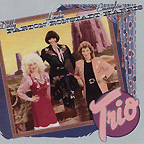 Linda Ronstadt/Emmylou Harris/Dolly Parton "Trio" (Warner Brothers, 1987)
(Produced by George Massenburg)
Dolly, Linda and Emmylou had been hanging out together for years before they made this album, singing backup for one another on various albums throughout the '70s, and horsing around in the studio for a while. Here they set out to formalize the arrangement, and the result sure was nice. Yeah, in the aggregate I guess it is a bit syrupy, but in a sense that's kind of the point. When they hit their mark, though, it's pretty darn nice.
Linda Ronstadt "Canciones De Mi Padre" (Warner Brothers, 1987) (LP)
(Produced by Peter Asher & Ruben Fuentes)
On the heels of her controversial but highly successful embrace of sleek, 1950s-style, post-big band "American songbook" pop vocals, Ronstadt further shook things up with this album, in which she reclaimed her Mexican-American heritage and delved into mariachi and ranchera music and gave a nod towards one of her childhood heroes, ranchera icon Lola Beltran. Though this sudden, unexpected turn raised a few eyebrows, as with the Nelson Riddle collaboration, it was a big commercial and critical success, selling two million copies, inspiring a multi-country tour, and scoring Ronstadt a Grammy award in '87.
Linda Ronstadt "Mas Canciones" (Elektra Records, 1991) (LP)
(Produced by Ruben Fuentes & George Massenburg)
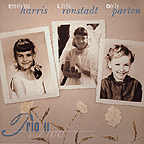 Linda Ronstadt/Emmylou Harris/Dolly Parton "Trio II" (Asylum Records, 1999)
(Produced by George Massenburg)
The rootsy feel of the first Trio album is subsumed to the sugary side of their musicmaking... Even though the formula is basically the same -- down-to-midtempo ballads with an acoustic backing and fine, three-part harmonies -- the magic doesn't seem the same. I wouldn't say they're coasting, exactly -- everyone seems to have their heart in it -- but they do seem lost n the technical craftsmanlike aspects of the project, neglecting that subtle roughness that makes good country music sound so great. It's an easy trap to fall into, considering how sweet these gals sound together, but it still makes for an overly bland album... Kind of a snoozer, really.
Linda Ronstadt & Emmylou Harris "Western Wall: The Tucson Sessions" (Asylum Records, 1999)
(Produced by Glyn Johns)
What? Did Dolly have something better to do that week...?
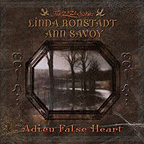 Linda Ronstadt & Ann Savoy "Adieu False Heart" (Vanguard Records, 2006)
Going by the name of "the Zozo Sisters," Americana doyenne Linda Ronstadt and cajun chanteuse Ann Savoy resume the partnership that sparkled and shone on the Evangeline Made compilation a few years back. This is a sweet set of uniformly lovely tunes, some more cajun than others, but all featuring gentle acoustic backing and wonderful vocal harmonies. Old-timey picker Dirk Powell lends his talent to the mix, as do a Balfa and Broussard or two, and the cream of the bluegrass studio crew... There's not much variety in the tempo or tone, but if pretty music is what you're looking for, this disc would be hard to beat.
Links


Hick Music Index

 Back in the 1970s, Linda Ronstadt was, literally, the poster girl for the Southern California country-rock movement, palling around with all the hot young musicians in the drug-soaked scene, while recording several sweet albums of cannily crafted country-folk-pop. The Eagles were originally her backing band, and her clique of collaborators included talents such as songwriter J. D. Souther and others. Like Emmylou Harris, Ronstadt was known for her track record spotting talented songwriters, and for championing their work... By the end of the decade, Ronstadt had become more of a pop singer, with a more overt emphasis on rock and disco, but for country fans, her early albums hold a lot of gentle jewels...
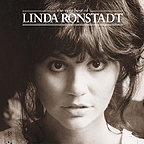 Linda Ronstadt "The Very Best Of Linda Ronstadt" (Rhino Records, 2002)
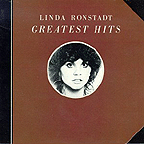 Linda Ronstadt "Greatest Hits" (Asylum Records, 1976) (LP)
 Linda Ronstadt "Greatest Hits, v.2" (Asylum Records, 1980) (LP)